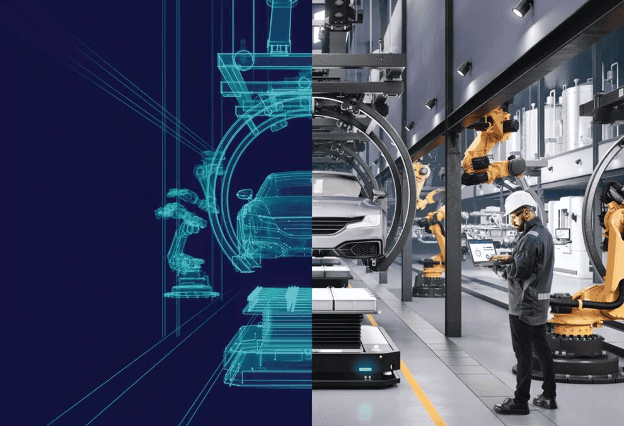
Essentially a digital replica of a physical asset, system or process, a digital twin can help companies create better products faster. They also promise to transform product development.
However, it’s important that manufacturers choose the right digital twin software for their needs.
Rahul Garg, vice president of industrial machinery and SMB programs, Siemens Digital Industries Software, says he’s seen a recent uptick in digital twins among customers. Influencing factors include the pandemic, demand for more collaborative work environments, workforce attrition and the need to attract new people.
“Even five years ago, small and medium-sized companies and suppliers were not all that keen to adopt new technology,” Garg says. “But I would say in the last 24 months, we are seeing a big shift within these industrial companies, where they are looking to say, ‘What got us here is not going to maintain us because there have been significant shifts in the industry, there’s been significant shifts in the business climate and we need to get up to speed.’”
Who’s Twinning?
However sluggish Siemens’ automotive customers may have been in latching onto digital twins, the manufacturing industry overall is all-in.
There is interest across several verticals—aerospace and defense, automotive, healthcare and energy—with manufacturing industries, both discrete and process, as the early adopters, says Sameer Kher, senior director, r&d - digital twins at Ansys Inc., Canonsburg, Pa.,. That’s due to the availability of connectivity solutions via technologies such as 5G, increasing competition, a growing need to support remote monitoring and the stationary nature of the equipment that makes it easy to keep tabs on.
Customers tend to be either product manufacturers or equipment operators, Kher adds. Product OEMs are more interested in predictive maintenance, minimizing warranty costs and in new and improved services, while operators seek to improve their operations.
Europe, with its focus on sustainability, and North America, with the increasing need to enable remote scenarios, are leaders in adopting twins, Kher says. For example, sustainability often involves minimizing energy usage.
“Digital twins can provide the necessary insights needed to optimize operations while minimizing energy waste and without sacrificing productivity,” he says.
The Smart Factory by Deloitte @ Wichita deployed a digital twin to optimize its energy management.
“We have battery-powered energy, we have windmill-powered energy, we have solar power and we have the traditional grid,” says Lindsey Berckman, U.S. aerospace and defense leader and principal, Deloitte Consulting LLP. “It allows us to know how we’re going to pick up from various energy sources at different times, to keep our costs as effective as possible and to use as much sustainable energy as possible versus drawing off the traditional grid.”
A Twin by Any Other Name
Definitions are a bugaboo throughout manufacturing, and the same applies to digital twins.
“Digital twin technology uses Industrial Internet of Things sensors, machine learning and simulation software to collect product data and generate accurate models,” says PTC Inc. CTO Steve Dertien. “Teams can then use the models to predict maintenance needs, simulate changes to the system and optimize processes (e.g., safety protocols, reporting procedures, manufacturing processes, etc.).”
What Dertien describes as a digital twin, Dassault Systèmes calls a “virtual twin.” While a digital twin is not a simulation, some settle the difference by using the terms “static digital twin” for a simulation and “dynamic digital twin” for a PTC-defined twin.
“A digital twin is much more than a simulation,” Dertien says. “A simulation mirrors a physical process, place, person, or product—it never once measures its counterpart. It is an unanchored digital representation of a physical location but without the constant measuring and reflecting that goes on with a digital twin.
“Boiled down, digital twins can only exist if they have a physical counterpart while simulations do not necessarily need any real-world counterpart,” Dertien continues. “A digital twin also spans the full product lifecycle.”
Sameer Kher, senior director, r&d - digital twins at Ansys Inc., also clarifies the difference.:
“An important differentiator (between simulation and digital twin) is that in most cases, the simulation models need to be transformed into more lightweight, self-contained versions that can be executed in near real-time on the edge or on the cloud,.” Kher explains.
Using reduced-order modeling (ROM) make the simulations more “lightweight” and encourages their reuse in creating a digital twin. This is a software technique Ansys uses in its applications to reduce the complexity of computing high-fidelity mathematical models while keeping their essential features and behaviors intact.
Without ROM, full-order models would be either unusable or prohibitively expensive to use in terms of compute time.
Software Advances & Challenges
Cloud computing, artificial intelligence and IIoT technology have contributed to explosive growth in the digital twin software market, which is predicted to grow from $11.5 billion in 2023 to $65.4 billion by 2030, representing a combined annual growth rate of 28%, according to Verified Market Reports.
However, building a twin is tricky. Early adopters report challenges in integrating digital twin technologies into their existing digital-product-development environment and wider IT infrastructure, according to the McKinsey report.
As with any digital and/or connected technology, cybersecurity is also a concern for twins.
“A digital twin could be a goldmine for cybercriminals,” Mysore warns. “Data security is extremely important to implement and continuously upgrade with robust security measures including encryption, secure access controls, and a regular review and update of security policies and practices.”
In addition to creating their own risks, digital twins also could make their physical counterparts vulnerable , adds Ramsey Hajj, global OT cyber leader at Deloitte & Touche LLP and cyber leader of Deloitte’s smart factory. “You have to guard your digital twin just like you’d guard your factory, because if somebody got a copy of your digital twin, he could sit at his desk with a pair of goggles on and rob you (virtually) a thousand times till he gets it right, and then go try it for real in your factory,” Hajj says.
A lack of a roadmap and trickiness in creating a twin aside, the promise they hold for expediting product development, optimizing processes and predicting machine maintenance is almost supernatural in providing a comprehensive line of sight to everything in a manufacturing plant, says Trent Still, principal, technical marketing, design and manufacturing at Autodesk Inc.
“What digital twin allows you to do is, for lack of a better word, be somewhat clairvoyant, and say, ‘I know what’s going to happen in that space;, I know exactly what should happen in that space,’” Still says. “So, they can focus on actually producing their products with confidence. Otherwise, manufacturing is purely reactive.”
Choices & Key Questions
Unfortunately, there is no predetermined roadmap to follow, says Prashanth Mysore, senior director, global strategic business development for manufacturing and supply chain, Dassault Systèmes.
“One question I always get asked is ‘what is the journey of a digital twin? When can you give me the roadmap?’” he says. “This is what most of the CEOs and head of operations normally ask. There is no one size fits all. I would say start at any stage.”
The most common advice about where to start is often posed in question form: What problem are you trying to solve? Where will you get the most value?
“There’s lots of software out there, (and) most of the software packages address a portion of the twin story,” Berckman notes. “There’s not a silver bullet that really goes the lifecycle, and will give you all of the different types of twin models and simulation capabilities that you would need. . … We advise for multiple kinds of software, depending on the part you’re focused on, the lifecycle and the problem that you’re trying to solve.”
In other words, not all twin software is alike, and deploying a number of digital twins requires an a la carte strategy. There are upfront questions to ask to make the right picks.
Other starter questions include:
Does the software use hybrid analytics?
Is the software open or closed?
Is it scalable?
How does it handle various types of data?
“Software that enables the use of hybrid analytics, combining physics via simulation with data via artificial intelligence and machine learning techniques leads to accurate, evolving models,” Kher notes.
Open architecture, meanwhile, allows for scalable deployments across the ecosystem and enables a manufacturer to choose the software that best fits its needs without being locked in to one vendor.
Autodesk’s architecture is closed, but it facilitates integration with APIs and is moving toward an open system, says Jason Love, technology communications manager.
“Autodesk software itself and its architecture is not open in the ‘open source’ sense—people outside Autodesk can’t look at the code and adjust it to suit their needs—but the tools, system and platform for digital twins is very open in the extensibility sense,” Love says.
Embedded machine models, compatibility with existing systems, and the ability to build a twin in incremental steps make using the application easier. Using an incremental approach, disparate teams such as electrical, mechanical and automation experts can contribute to the twin’s creation concurrently and work more collaboratively, according to Garg.
And scalability is especially important to research for startup software companies, Berckman says. This ensures the software can handle larger datasets as a shop or enterprise’s twins proliferate and grow.
Underscoring the need to handle a wide range of data, , one Dassault customer has 100-plus software applications in use and is unsure about how to integrate OT and IT data from the various sources.
“It’s like a museum of software,” Mysore says. “So, we suggested an interoperability model.”
Siemens answer to data integration is its Insights Hub. Although it’s not plug-and-play, the company offers a low-code solution, Mendix, to build connectivity.
“It’s a drag-and-drop process to build these integrations,” Garg says. “In fact, we created an integration between Mendix and Amazon’s AI engine. So, you can literally use generative AI as part of the process of bringing different data sources.”
Not Just for IIoT
There’s no available data to support a connection, but Garg’s observation of an uptick in American industry coincides with 2022 legislation including the Chips and Science Act and the Inflation Reduction Act. Both provide money to manufacturers as Washington tries to bolster onshore manufacturing.
One use for such funding is to create a twin when setting up a new factory or expanding an existing plant.
“For the enterprise, it’s more often than not they’re looking at complete retooling of a manufacturing facility or building a net new facility,” Autodesk’s Still says. “Therefore, they’re taking into account things like where the trucks come in and where they leave? Where do the rovers go?”
Existing plants can also benefit from a twin, Still continues, pointing to the challenges of growth. “The most interesting to me are when small and medium-sized manufacturers are experiencing a hyper-growth state of their business,” he says. “And more often than not, they’re looking to do a couple things: diversify or digitalize their automation processes with regard to robotic tenders—sorting machines or anything like that—or they’re looking at new machine acquisition to accommodate more spindle time and (in job shops) to accommodate more opportunities.”
Autodesk’s Fusion software facilitates digital twins of machines, while its FlexSim discrete event simulation application enables design and automated factory-floor solution twins. Fusion Operations is for digital twins of throughput.
A digital twin enables factory owners to create a digital footprint, and effectively lay out their machine lines, even before issuing a purchase order for a new CNC, Still explains. Capabilities include examining clearances—accommodating forklifts and robots—determining how material can be unloaded or loaded with a crane, and everything else that happens in a plant.
Digital twins incorporate cohesive simulation of workflows, he continues, including where a part is going to come off a line, then go to the CMM machine, then to QA for tolerance and finished analysis, then on to packaging,.
As a result, a twin can prevent some very costly mistakes.
“Historically, this had been a very bifurcated processes,” Still says. “Architects and engineers design a building; they think that they know where the machines are going to go.
“Then when a manufacturer takes ownership and throws all their machines in there and realizes half of the MEP (mechanical, electrical and plumbing) is in the wrong place,” Still says. “So, they have to cut the floor up, they have to redo the floor to accommodate the point loads and machines.”
In these cases, a digital twin isn’t just pulling IoT data off of a CNC machine. “It’s that and everything else,” Still asserts.
The 3DExperience platform is Dassault’s solution for improving worker safety and production throughput by optimizing flow, accessibility and space and throughput with a digital twin.
“We do it by optimizing the layout,” Mysore says. “Maybe we suggest rearranging the machines, rearranging the product flow, installing an extra machine, reorienting the layout to bring in methodology to improve productivity. It’s a simple thing that can really help most of our manufacturers.”
The Best of Both Worlds
Two software companies have developed a hybrid offering that combines the power of simulation and IIoT to extend service-optimization solutions. In this context, the latter can be broad but would include field service and service parts inventory optimization, Dertien explains.
PTC and Ansys’ simulation-enhanced digital twin combines PTC’s ThingWorx IoT data with Ansys Twin Builder simulation to build a virtual replica that mirrors the life and experience of a connected asset. Users can deploy the digital twin to reduce operational costs through remote monitoring, improved diagnostics and predictive service while improving their ROI by running assets at optimum performance.
The use of simulation is essentially for a virtual sensor of some type (accelerometer, vibration, machine rotation, temperature, proximity, etc.) for conditional or operational monitoring, resulting in a better service experience for customers.
“For example, your car does something similar with oil changes now,” explains Steve Dertien, chief technology officer of Boston-based software specialist PTC Inc. . “You used to get it changed every 3,000 miles. Now it’s condition-based and an algorithm is used to calculate oil life percentage.”
The Ansys-PTC solution is ideal, he says, for process-critical applications that operate in challenging environments where assets have a high downtime cost or are complex for local technicians to maintain, or both.
Good Twin, Imperfect Twin
Even the best digital twin is only as good as the simulation it’s based on.
“Simulations vary vastly between what we see in a normal engineering scenario versus the reality that some of them represent when utilized,” Dertien says. “This is an area that is perhaps one of the most understated and complex areas, particularly if you take a process that has never had a modeled simulation before.”
For example, if a production process mixes multiple chemicals together to produce a foam, there’s no sensor to measure the qualities of a good foam in some of these cases, he says. There’s also very little known on what an effective simulation model should be for that reaction.
“This remains an area that requires the most crafting for the more advanced scenarios,” Dertien says.
In other words, there’s more work to be done.
About PTC
PTC (NASDAQ: PTC) is a global software company that enables industrial and manufacturing companies to digitally transform how they design, manufacture, and service the physical products that the world relies on. Headquartered in Boston, Massachusetts, PTC employs over 7,000 people and supports more than 30,000 customers globally. For more information, please visit www.ptc.com.