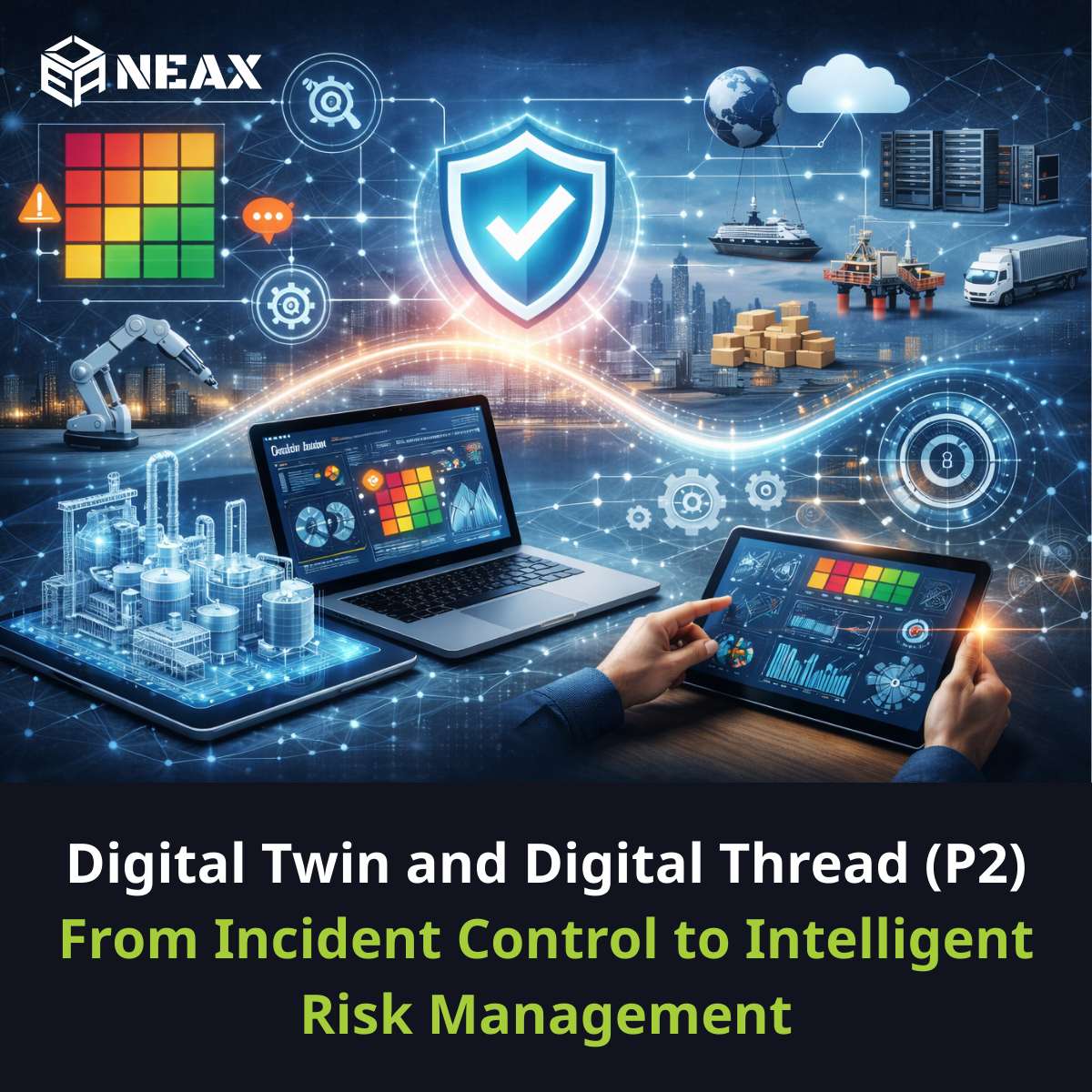
In an increasingly volatile business environment, risk management can no longer be limited to tracking and reporting incidents; it must become an integral part of corporate strategy. Within the Enterprise Risk Management (ERM) framework—particularly under the COSO ERM model*—Digital Thread and Digital Twin can serve as the data and analytics infrastructure that enables organizations to enhance the entire risk cycle of identification, assessment, response, and monitoring.
(*) COSO ERM is a strategy-integrated risk management framework that helps organizations manage risk in alignment with value creation and performance objectives.
Aligning risk with strategy
COSO ERM emphasizes the integration of risk considerations into the strategic planning process. A Digital Twin enables organizations to simulate strategic scenarios such as technology shifts, energy price volatility, supply chain disruptions, or emerging climate requirements. When data from the Digital Thread is connected across the entire product and asset lifecycle, companies can quantify the operational and financial impacts of each scenario before making decisions. This transforms ERM from a qualitative assessment approach into a model- and data-driven analytical framework.
Data-Driven risk identification and assessment
Within ERM, effective risk assessment requires accurate and timely information. The Digital Thread provides configuration traceability, change history, and operational data at the asset or batch level. The Digital Twin adds predictive analytics capabilities, enabling organizations to estimate failure probabilities, identify process bottlenecks, or detect emission threshold breaches. As a result, risk matrices are no longer based on subjective assumptions but on real-time data and predictive modeling.
Strengthening internal controls and continuous monitoring
ERM requires the establishment of effective control and monitoring mechanisms. The Digital Thread supports version control, change management, and comprehensive tracking of all engineering modifications, forming a solid foundation for internal control and audit processes. The Digital Twin enables continuous monitoring of performance indicators and operational risk metrics, allowing early detection of deviations from established control thresholds. Together, these capabilities help reduce operational risk, compliance risk, and reporting risk.
Enhancing response and resilience
An effective ERM system not only focuses on prevention but also strengthens organizational resilience. A Digital Twin can simulate crisis scenarios such as equipment failures, raw material shortages, or logistics disruptions. Meanwhile, the Digital Thread ensures rapid traceability to determine the scope of impact and implement corrective actions. This capability shortens response time and minimizes potential losses.
.png)
Within a modern ERM framework, the Digital Thread serves as the data infrastructure that ensures transparency and traceability, while the Digital Twin provides simulation and predictive analytics capabilities. When integrated into the enterprise governance architecture, these two platforms transform ERM from a traditional risk management model into a risk intelligence architecture—where risks are measured, simulated, and managed proactively, continuously, and in direct alignment with corporate strategy.